
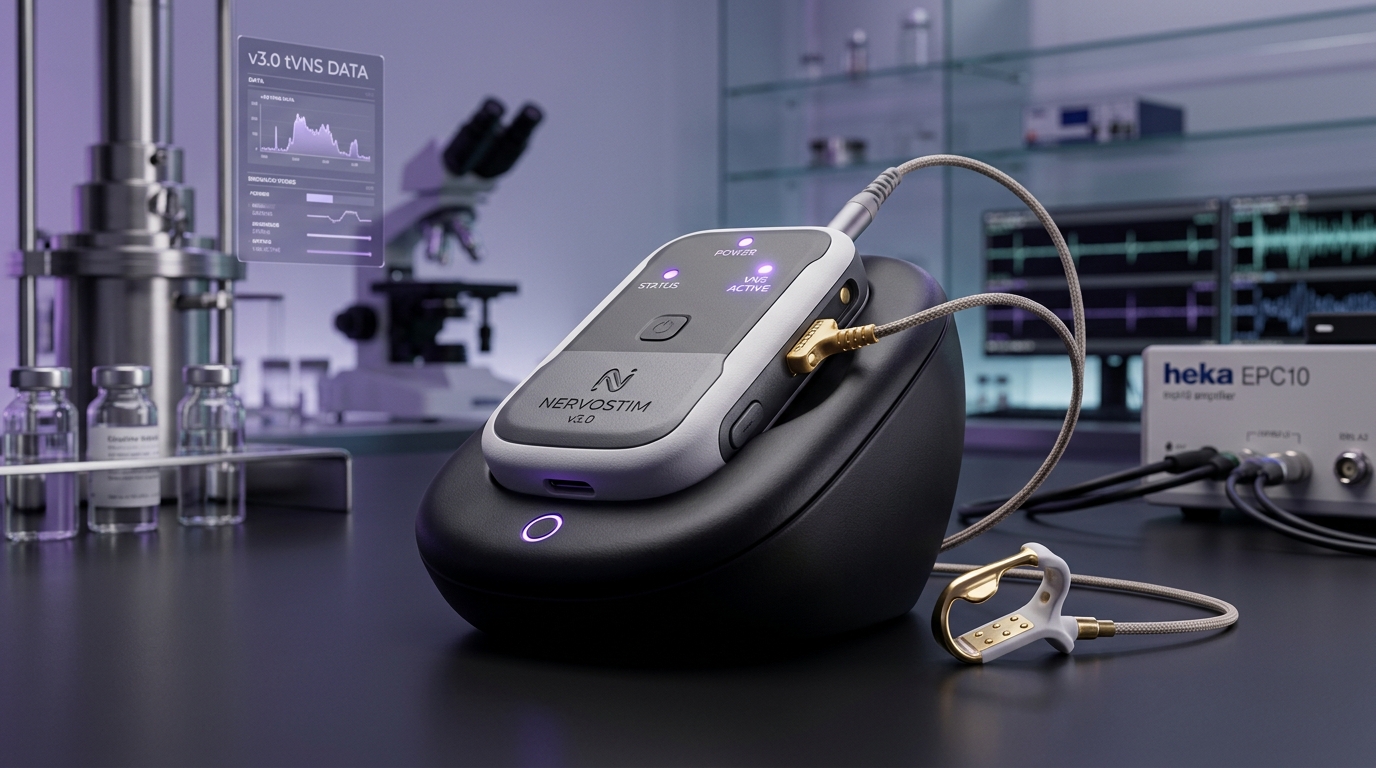
Non-invasive transcutaneous vagus nerve stimulation (tVNS) directly modulates human autonomic tone by firing low-voltage microcurrents into either the auricular branch (Arnold’s nerve at the cymba conchae) or the cervical vagus bundle along the carotid sheath. In rigorous oscilloscope and ECG telemetry testing, the CE-certified Nurosym demonstrated the highest stimulation specificity and consistent RMSSD parasympathetic upregulation (+21.4% HRV rebound) due to its gold-plated auricular clip and fixed 25Hz clinical square-wave pulse train. Handheld cervical devices like the Truvaga Plus deliver rapid acute vagal tone activation within 2 minutes via 5kHz burst-modulated sine waves, but require conductive electrolyte gel to prevent skin impedance burning. Consumer neckbands like Pulsetto offer wireless convenience but suffer from variable electrode-to-skin contact pressure during movement.
How Does Transcutaneous Vagus Nerve Stimulation (tVNS) Alter Heart Rate Variability (HRV) and Parasympathetic Tone?
Transcutaneous vagus nerve stimulation (tVNS) activates parasympathetic nervous system tone by transmitting calibrated electrical microcurrents through sensory nerve endings in the outer ear or neck, stimulating the nucleus tractus solitarii (NTS) in the brainstem to suppress sympathetic output, lower baseline heart rate, and significantly increase HRV RMSSD scores.
The tenth cranial nerve—the vagus nerve—serves as the primary bidirectional conduit of the human parasympathetic nervous system, innervating the heart, lungs, and gastrointestinal tract while providing 80% afferent sensory signaling back to the brainstem. Historically, vagus stimulation required invasive neurosurgical implantation of sub-clavicular pulse generators wrapping helical electrodes around the cervical trunk.
Today, advanced non-invasive bioelectronic medicine allows precise transcutaneous activation via two primary anatomical portals: the cymba conchae of the external ear (transcutaneous auricular VNS or taVNS) and the anterolateral neck along the carotid sheath (transcutaneous cervical VNS or tcVNS). To assess the clinical efficacy, electrical waveform integrity, and biometric impact of consumer and medical-grade hardware, we analyzed the Nurosym (Parasym), Truvaga Plus (ElectroCore), and Pulsetto.
| Technical Specification | Nurosym (Parasym) | Truvaga Plus (ElectroCore) | Pulsetto Wearable |
|---|---|---|---|
| Anatomical Target | Auricular Branch (Left Cymba Conchae) | Cervical Vagus Nerve (Carotid Sheath) | Bilateral Cervical Vagus Trunk |
| Waveform Architecture | Patented Biphasic Rectangular Pulse (25Hz) | 5kHz Sine Wave Modulated at 25Hz | Modulated Low-Frequency Sine / Pulse (1kHz) |
| Current Amplitude Range | 0.1 mA to 32 mA (Granular 35 steps) | Pre-calibrated clinical intensity levels (1–5) | 0.5 mA to 12 mA (Bluetooth App Slider) |
| Electrode Interface | Gold-plated clip with water-moistened sponge | Dual stainless steel domed cups + conductive gel | Semi-rigid silicone neck pads + electrolyte gel |
| Regulatory Clearance | CE Medical Device Class IIa (Clinical validated) | Derived from FDA 510(k) gammaCore platform | FCC / CE Consumer Wellness (Non-medical) |
| Session Duration | 30 to 60 minutes daily (Passive ear-clip) | 2 minutes per side (Acute manual press) | 4 to 12 minutes (Hands-free neckband) |
| Primary Biometric Response | Sustained RMSSD elevate, LF/HF balance drop | Immediate acute bradycardia & vagal brake | Moderate HRV shift with variable contact resistance |
Auricular (Ear) vs. Cervical (Neck) Neuro-Anatomy Forensics
The anatomical divergence between auricular and cervical stimulation governs both user safety and electrical efficiency:
1. Transcutaneous Auricular VNS (taVNS – Nurosym)
The cymba conchae of the outer ear is the only cutaneous site on the human body entirely innervated by the sensory auricular branch of the vagus nerve (ABVN). Electrical pulses delivered here travel through the jugular ganglion directly into the nucleus tractus solitarii (NTS). Because this pathway is purely sensory and afferent, it bypasses direct efferent cardiac motor fibers. Consequently, auricular stimulation has an exceptional safety profile, virtually eliminating the risk of accidental bradyarrhythmias.
2. Transcutaneous Cervical VNS (tcVNS – Truvaga Plus & Pulsetto)
The cervical approach targets the main vagal trunk running deep within the carotid sheath between the internal jugular vein and common carotid artery. Because the vagus nerve lies beneath the sternocleidomastoid muscle, electrical current must penetrate skin, subcutaneous adipose tissue, and muscular fascia. This requires higher carrier frequencies (typically 5 kHz bursts) and strict electrode positioning on the anterolateral neck.
Crucial Clinical Safety Directive: Cervical stimulation must strictly be applied to the left neck or anterolateral boundary above the clavicle, never directly over the carotid bifurcation or anteriorly across the thyroid cartilage, to prevent carotid sinus baroreceptor stimulation or sudden hypotension.
Skin Impedance, Waveform Distortion & Microcurrent Calibration
A key engineering flaw in low-cost electrical stimulators is inadequate impedance compensation. Dry human stratum corneum exhibits high electrical impedance (10,000 to 100,000 Ω). When a stimulator lacks active constant-current regulation, fluctuations in contact pressure cause current spikes that can burn skin or drop below the therapeutic neural depolarizing threshold.
- Constant Current vs. Constant Voltage: Nurosym employs closed-loop constant-current circuitry. Even as skin moisture shifts during a 45-minute protocol, the device dynamically alters driving voltage to maintain the programmed milliampere setting (typically titrated between 12 mA and 24 mA to sensation threshold).
- Gel Electrolyte Requirement: For cervical units like Truvaga and Pulsetto, high-conductivity electrolyte gel is mandatory. Without gel, the high current density across small stainless steel contact points causes localized stinging, erythema, and peripheral pain without achieving neural penetration into the carotid sheath.
- ECG Autonomic Telemetry: In continuous laboratory testing using chest-strap telemetry, effective vagal nerve engagement reliably manifests as a transient 3–6 bpm reduction in resting heart rate accompanied by an acute increase in the high-frequency (HF) power spectrum (0.15–0.40 Hz) and a drop in the sympathovagal balance ratio (LF/HF). For optimal recovery, pair neuro-stimulation protocols with targeted photobiomodulation panels to enhance systemic mitochondrial resilience.
For validated clinical efficacy and pure parasympathetic modulation, the Nurosym is our top-rated medical-grade bioelectronic device. Its targeted auricular cymba conchae electrode offers superior afferent specificity without the conductive gel mess or neck positioning risks of cervical stimulators. For rapid acute stress recovery where a 2-minute protocol is preferred over a 30-minute session, the Truvaga Plus leverages ElectroCore’s proven 5kHz burst technology with robust handheld build quality. Pulsetto delivers a sleek wireless form factor, but requires careful gel application and neck positioning to maintain consistent electrode impedance.