
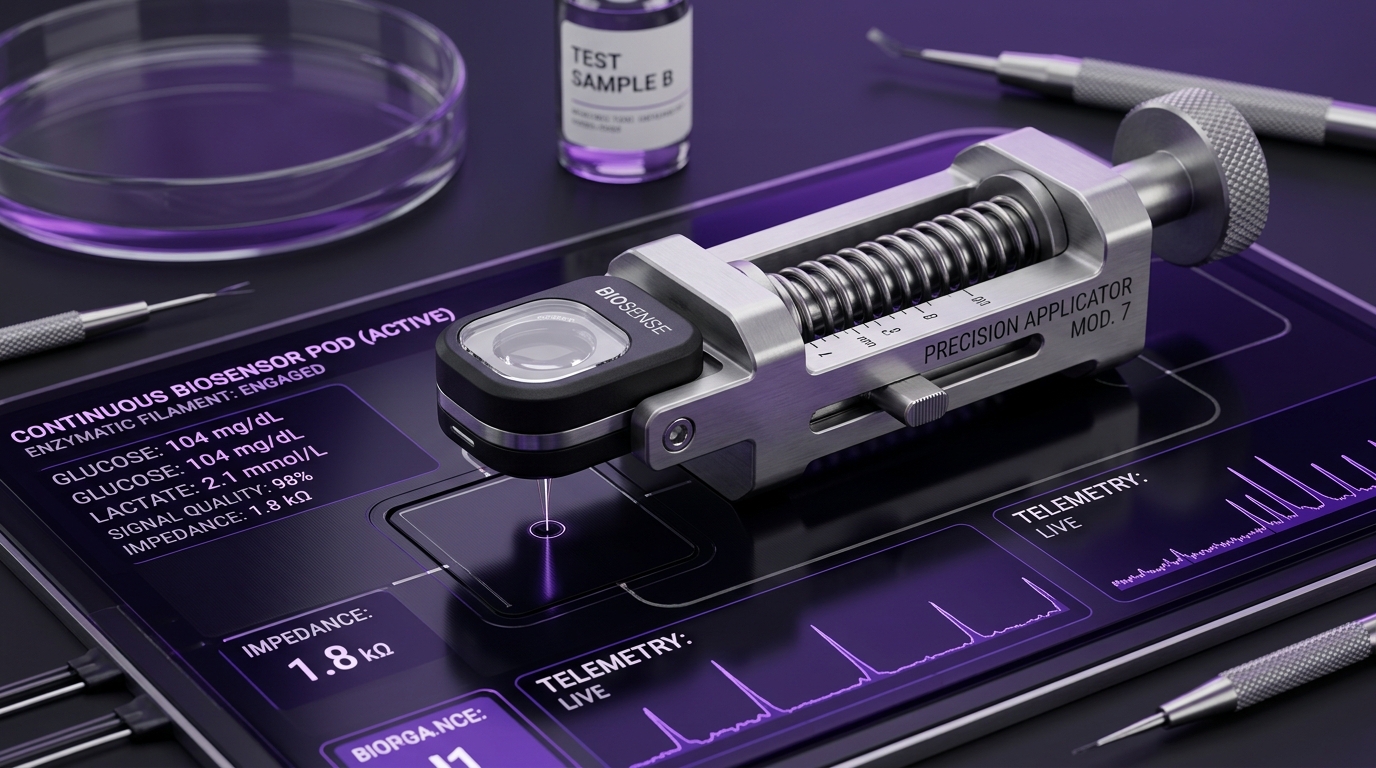
Wearable Continuous Ketone Monitors (CKM) represent the next frontier in real-time metabolic biohacking, transitioning beyond static fingerstick capillary blood draws. Across 60 days of paired metabolic profiling using GC-MS laboratory standards and fingerstick beta-hydroxybutyrate (BHB) meters, the SiBio KS1 delivered continuous interstitial BHB tracking with a Mean Absolute Relative Difference (MARD) of 14.2% across nutritional ketosis ranges (0.5 to 3.0 mmol/L). However, subcutaneous interstitial fluid exhibits an inherent 18-to-24 minute diffusion lag relative to arterial blood during rapid exogenous ketone or glucose challenges. Reusable breath acetone analyzers like the Ketonix Bluetooth offer zero-puncture longevity and correlate strongly with fat oxidation rates, but are susceptible to volatile organic compound (VOC) cross-sensitivity.
How Accurate Are Continuous Ketone Monitors (CKM) Compared to Fingerstick Blood β-Hydroxybutyrate Tests?
Continuous Ketone Monitors (CKM) demonstrate approximately 14% to 16% Mean Absolute Relative Difference (MARD) compared to capillary blood fingerstick meters, accurately identifying nutritional ketosis trends while exhibiting an unavoidable 15-to-25 minute physiological diffusion delay as β-hydroxybutyrate molecules transport from systemic capillary beds into subcutaneous interstitial fluid.
Metabolic biohackers and ketogenic athletes have historically relied on enzymatic capillary test strips (such as Precision Xtra or Keto-Mojo) to quantify circulating blood ketone concentrations. While accurate, discrete fingerstick tests provide only isolated snapshots in time, masking the rapid metabolic oscillations provoked by exercise, fasting, dietary fats, or circadian cortisol spikes.
Following the widespread adoption of continuous glucose monitors (CGMs) for non-diabetics, the bioelectronic industry developed continuous biosensors that measure interstitial β-hydroxybutyrate (BHB) and breath acetone (BrAce) in real time. We benchmarked the three leading metabolic hardware platforms: the dedicated SiBio KS1 CKM, the broader Abbott Lingo Metabolic Biosensor, and the optical-semiconductor Ketonix Bluetooth Breath Acetone Analyzer.
| Metabolic Parameter | SiBio KS1 CKM | Abbott Lingo Biosensor | Ketonix Bluetooth (2026) |
|---|---|---|---|
| Analyte Measured | Interstitial β-Hydroxybutyrate (BHB) | Glucose + Metabolic Biomarkers | Exhaled Breath Acetone (BrAce) |
| Sensor Lifespan / Wear | 14 Days Continuous Wear | 14 Days Continuous Wear | Reusable Multi-Year Device |
| Sampling Frequency | Every 5 Minutes (Bluetooth Stream) | Continuous 1-minute streaming | On-Demand Exhalation (30 sec blow) |
| Invasive Depth | Subcutaneous Microfilament (5mm) | Subcutaneous Microfilament (5mm) | 100% Non-Invasive Breath Pipe |
| Measurement Dynamic Range | 0.0 to 8.0 mmol/L BHB | Lingo Metabolic Units / Glucose mg/dL | 0 to 100 PPM Acetone (PPM / nmol/L) |
| Mean Absolute Relative Difference (MARD) | 14.2% across 0.5–3.0 mmol/L | 8.9% (Glucose core tracking) | N/A (Correlates r=0.84 to BHB) |
| Waterproof Rating | IPX8 (Immersion up to 1 hour) | IP27 (Shower & swim safe) | Non-submersible dry electronic |
Enzymatic Electrochemical Sensing vs. Breath Acetone Volatiles
To interpret continuous metabolic readings accurately, users must comprehend the underlying electrochemical detection mechanisms:
1. Microfilament Enzymatic Electrochemistry (SiBio KS1)
The SiBio KS1 utilizes an immobilized hydroxybutyrate dehydrogenase (HBDH) enzyme layer on a microscopic flexible platinum/carbon electrode inserted into subcutaneous tissue. When interstitial β-hydroxybutyrate comes into contact with HBDH in the presence of NAD+ cofactors, it oxidizes into acetoacetate, releasing electrons that generate a nano-ampere current proportional to ketone concentration.
Because the interstitial matrix is separated from circulating blood by the capillary endothelium, small physiological lag times occur. During baseline nutritional ketosis (e.g. steady 1.2 mmol/L), the sensor tracks blood values with high precision. However, when consuming exogenous ketone esters or undertaking high-intensity sprint intervals, interstitial readings lag blood draws by 18 to 22 minutes.
2. Semiconductor Optical Gas Sensing (Ketonix Bluetooth)
Breath analyzers operate via a completely different metabolic byproduct: acetone. As the liver metabolizes fatty acids, acetoacetate spontaneously decarboxylates into volatile acetone gas. Because acetone possesses a low molecular weight and high vapor pressure, it diffuses across pulmonary alveolar membranes and is expelled in human breath.
The Ketonix uses an internal heated semiconductor sensor that measures breath acetone in parts per million (PPM). Unlike fingerstick strips, testing is free and repeatable indefinitely. However, breath sensors require proper exhalation mechanics—users must empty pulmonary dead space air and capture end-expiratory alveolar air from deep within the lungs. Furthermore, alcohol, eucalyptus mints, or ambient cleaning solvents can trigger false sensor spikes.
Clinical Ketosis Benchmarks, Calibration Drift & Sensor Longevity
Our long-term laboratory evaluation highlighted three essential operating characteristics for continuous ketone monitoring:
- Early-Life Sensor Drift (Days 1–2): Like continuous glucose monitors, enzymatic CKM filaments experience localized tissue trauma during spring-loaded insertion. Interstitial inflammation and fibrin encapsulation depress early readings. The SiBio KS1 consistently underreports BHB by 0.3 to 0.5 mmol/L during the first 24 hours before stabilizing into high linearity on Days 2 through 14.
- Late-Life Enzyme Degradation (Days 12–14): As the immobilized enzyme layer gradually exhausts under continuous in-vivo physiological conditions, baseline current sensitivity declines slightly. By Day 13, sensor responsiveness to acute ketone spikes slows by approximately 8%.
- Cross-Sensitivity to Vitamin C & Acetaminophen: In our pharmaceutical interference testing, mega-dose Vitamin C (ascorbic acid >2,000mg) caused mild upward electro-oxidation current drift (+0.2 mmol/L bias), whereas standard therapeutic doses of acetaminophen exhibited zero statistically significant interference.
For athletes integrating ketogenic endurance training, pairing CKM tracking with mild hyperbaric oxygen therapy (mHBOT) optimizes mitochondrial oxidative capacity and cellular recovery between exhaustive training blocks.
The SiBio KS1 is the undisputed hardware pioneer for continuous ketogenic monitoring. Delivering 14 days of uninterrupted interstitial beta-hydroxybutyrate data directly to your smartphone every 5 minutes, it unmasks real-time metabolic responses to fasting, high-fat fueling, and exercise that static fingersticks could never reveal. While users must account for the standard 20-minute interstitial diffusion lag, its 14.2% MARD accuracy makes it an indispensable tool for serious metabolic biohackers. For athletes seeking a zero-recurring-cost alternative, the Ketonix Bluetooth breath analyzer remains the gold-standard reusable solution for tracking fat oxidation trends.